"Movies are a complicated collision of literature, theatre, music and all the visual arts." - Yahoo Serious

May 18, 2004

LLLS 4 Agent of Doom

A Love is Born from Violence

The Late-Late-Late Show Project, yet another vain attempt to extrapolate meaning, correlations, and unsure and precarious connections from the trailers of painfully obscure European genre films from the 50s and 60s as collected in Something Weird's Late-Late-Late Show VHS compilation, as referenced here. (1) (2) (3)

No.4 Agent of Doom, original French title Un Soir... par Hasard, which roughly translates as One Evening... by Chance. One Belgian site sketches a very brief synopsis, here translated (via Google): At the time of an accident of motor bike, the young atomic scientist André Ségonne is helped by a motorist. He awakes in an unknown house. A series of unexplainable phenomena soon will transform its life into hell... Science fiction and love story.

Aside from French online merchants like alapage, there's not much to go on concerning this curious film. From what I can gather from the trailer, Florence (played by the ravishing Annette Stroyberg, who also happened to be married to Roger Vadim at the time --and indeed, she is best known nowadays as Vadim's woman between his trysts with Bardot and Deneuve) is either a woman who enjoys eternal youth, or some sort of automaton. She's surrounded by two creepy old men (played by French film stalwarts Jean Servais and Pierre Brasseur), who may be her servants, or former lovers who suffer being her servants merely to be in the glow of her incredible youth and beauty. The young scientist (Michel Le Royer), convalescing in her mansion after a motorcycle accident (a colleague warns him before his excursion: "A motorcycle is a dangerous toy", to which our hero replies, "I'm not about to get killed. I like life too much."), finds himself falling in love with the mysterious Florence. He also finds that he may enjoy eternal youth as well. As arch harpsichord music plays, she tells him: "We'll never grow old, Andre. We'll never be apart." Then we see a jetliner's engine blow and toss young Andre across a runway like an autumn leaf. And the trailer ends.

If this description of the trailer seems remarkably vague, it is because the trailer to Agent of Doom is remarkably vague. Is it a romance, a fantasy story, a spy tale, or some sort of melange of all of them put together? One suspects that the American marketers who put together this trailer were unsure themselves. I imagine their prime directive was to show as much of Annette Stroyberg's bare back as possible.

Le lion et le rat by R. Lortac

One interesting sidebar to this film is the story of the man who wrote the novel on which this film is based, L'Aventure Commence ce Soir, or The Adventure Begins This Evening. His name was Robert Collard, but he is best known by his pseudonym R. Lortac, one of France's first animators. Inspired by Winsor McCay's films while on a trip to the United States, he began making animated films in the late teens. Some of these were distributed as 9.5mm films meant for the home market in the early '20s (by Pathé Baby, the first manufacturers of home movie equipment, and who also sold ready to view movies for their system such as Lortac's films, and also Chaplin shorts and different chapters of Abel Gance's Napoleon), and it's in this small format that what's left of Lortac's early work survives. He also started making advertising cartoons in the early '20s, which could be considered the first commercials. In 1922, he began his "Canard en cine" series, which were satirical cartoons shown along with newsreels.

Le Conquerants de l'Espace by R. Lortac

With the coming of the Depression in the 1930s and the advent of World War II, Lortac sold his animation studio and turned to a less taxing way to make a living, writing comic books and popular genre fiction. One of his comic book creations was Bibi Fricotin, a sort of Tintin in space. Another was a series published in Meteor Magazine, Les Conquérants de l'Espace (The Conquerers of Space), featuring the adventures of the space pilot Spade and his smart-talking mechanic Texas. He also started writing novels as Robert Collard, such as Les Bagnards du Ciel (Convicts of the Heavens), and the aforementioned L'Aventure Commence ce Soir. Little did people realize that this genre journeyman was also one of the pioneers of the animated film.

Yet more marginalia. The director of Un Soir... par Hasard, Yvan Govar, has been credited (accused?) by some genre fans as the director of the lost (never completed, or perhaps never even made) Paul Naschy werewolf feature Las Noches del Hombre Lobo (The Nights of the Wolfman). The story surrounding this non-film is fairly interesting, but best left for another time.

May 17, 2004

Glenn Branca

Streaming video hits you in the solar plexus! Here's a collection of performance videos from Glenn Branca and his electric guitar ensembles. Atonal and cool, and still going at it apparently.

May 14, 2004

Here's Inga!!

From Sweden... the classic female concept

Mp3 Friday! Back with a vengeance! This week we present the rocking Middle of Nowhere by The Good Grief, the title tune of the 1968 Swedish skin flick Inga. (Clay Pitts and Robert Sterling) 1.8M

"The most acclaimed masterpiece of erotic cinema ever created!" claims the blurb on the cover of the "Collector's Edition" DVD of Joe Sarno's Inga, or, as it was known in Sweden, where it was produced, Jag - en oskuld (I, a Virgin). Surely another case of an adman's hyperbole, as the film, a taciturn soap opera with some nudity, clearly does not live up to its billing (what film could, really?). The blurb itself seems quaint, from a time (not that long ago) when the promise of art could be used to push sex, at least making it high-minded enough to make the sex seem respectable. Pick up a copy of any Playboy from the 60s, and in between the gatefold and "The Girls of Rio" pictorial, you would find Nabokov, Bertrand Russell, and Marshall McLuhan. Sex became the thinking man's sport. In the arts, loosening the bounds of decency statutes became the province of poets and prurient hucksters alike.

The sex films of the period exemplified this odd dichotomy. Filmmakers like Sarno and Radley Metzger had pretensions to art, but still had enough T&A to appeal to the raincoat crowd. Inga is not an exception. With its crisp b&w photography, Swedish locations, and Scandinavian quietude, some have made the comparison to Bergman. This is a stretch. While a lot of it is artfully done, it shows nothing that compares to Bergman's moral weight. It's essentially a story of a woman who attempts to pimp out her teenage niece to a wealthy publisher "who likes young girls" in order to have the money to keep her much younger boyfriend. The niece ends up sleeping with the boyfriend, and the aunt finds herself with nothing in the end. Not necessarily a bad story, but it would have been better without the arthouse pretensions. Better as a Sirk, not a Bergman.

Marie Liljedahl

The main title for Inga is the song "Middle of Nowhere", written by Clay Pitts and Robert Sterling, and performed by The Good Grief. A very fuzzy guitar lead snakes around a classic mid-60s "shake" beat. The lyrics (in English) offer a critique of the nihilism and angst of youth: "Everybody's playing, but nobody's really winning...It's a paradox, they don't know if it's joy or pain...Believing that their friends are in hell (spooky sound from the organ)...And where does it take you to, if you refuse to care...The middle of nowhere!" I'm assuming The Good Grief are Swedish. The heavy fuzz gives it away, along with the singer's accent. I found nothing about the band on the web. The imdb has The Bamboos listed (they're listed as The Good Grief in the credits). While I couldn't find anything about The Bamboos, there is a Swedish band called Bamboo, whose claim to fame is that it launched singer Mikael Rickfors' career, first as a member of the 70s version of The Hollies, then as a solo artist. So, are The Good Grief The Bamboos in disguise? Does anyone care? One of the song's writers is Clay Pitts. The only other credit I could find for him is the soundtrack for another sex film (from 1970) Female Animal. There's an interesting discussion about the Inga soundtrack on the Mobius Euro Cult Board (scroll down to Scoring with INGA), alas with no resolution.

May 13, 2004

Your Littlest Gauge

100 ft of Monster Sized Love

Long before the advent of DVD, and way before the days of VHS and Beta, the very idea of collecting feature films for home viewing was impractical, cumbersome and horribly expensive. Sure, some worthy and enterprising souls collected 35mm and 16mm prints of their favorite movies, but normally these collectors were theater owners or had access to the hardware needed to project these reels. For those of lesser means who still wished to keep at least a small taste of a memorable film experience, alternatives might include recording an audio cassette off the late, late show, commercials carefully edited out (as I had done, many years ago, when local TV used to broadcast movies instead of infomercials in the wee hours), or, for the more adventurous, film favorite scenes directly off the television with a Super 8 camera (which I also tried, although with not much success). Or you can do what most reasonable people did: buy edited highlights of their favorite feature in a 100 to 400 ft Super 8 reel. These would usually run from 7 to 25 minutes, and would sort of synopsize the movie's story in that allotted time. Some were sound, but most were silent. Sketchy intertitles would not only function to show dialogue, but also to completely do away with exposition and provide the merest wisp of context with the previous scene. Thus, the 30 minutes of plot, gags and happenings between two scenes in, say, Abbott and Costello Meet Frankenstein can be reduced to a simple title: "After escaping Dracula, the boys find themselves in Frankenstein's lair".

These were highlight reels of your favorite movies, pure and simple. Cinema ESPN, if you like. An interesting question to pose, though: who were the editors of these expurgated editions? They were usually the employees of companies such as Castle Films (here's a nice history of Castle Films here), who bought a movie's rights from a studio, chopped them down to size, and then printed them in 8mm or Super 8 reels, often packaged in garishly designed boxes (here's a nice collection of images of these boxes). But these editors, how did they work? Did they study the full feature backwards and forwards in order to find the perfect abridgment? Or did they put in the exciting stuff, with no care at all to any semblance of narrative order? Did they follow a certain aesthetic?

Possibly the closest analogue to these truncated films are trailers, if only in the way a film can be distilled into an impossibly short length. Other than that, these little editions are quite unique, and, aside of a few collectors, pretty much forgotten. If one were so inclined, one could do an interesting study.

April 21, 2004

Yet Another Post about KB

Once more with panache

Yet another post about Kill Bill --Screencaps from the Japanese Region 2 disc. See the showdown at The House of Blue Leaves in all its colorful and gory glory.

New KB Edit?

Rumors are afloat that Tarantino intends to re-edit and fuse together both volumes of his Kill Bill opus for a year-end release for video and quite possibly for a limited release in theaters. Speculation on the DVD Times Forum is that a total re-edit of the structure is in the works and that one shouldn't expect a simple and expedient tacking on of the second volume to the end of the first.

I see troubles for film scholars ahead, not to mention for the well-being of film fans and collectors. I suppose this sort of reordering and refashioning of an ostensibly completed work began in earnest back in 1977 when Francis Ford Coppola re-edited parts I and II of The Godfather into a sprawling miniseries for NBC. What was notable for that endeavor, entitled The Godfather Saga, or The Godfather 1902-1959: The Complete Epic was not just the inclusion of outtakes of both movies but the chronological reordering of the events of Part II. While this may make some sort of narrative sense and assuage some of the confusion and insecurity some viewers may have felt trying to piece things together, it also undermined the complex thematic poignancy of the juxtaposition of the scenes of Little Italy and those in mid-century Tahoe. It was this juxtaposition that made The Godfather Part II a greater film, I feel, than its predecessor. Aesthetic considerations won out in the end, though, and both films (along with its sickly Fredo-like Part III) are available in a handsome boxed set, along with the outtakes that were included in the TV Saga. Of course, the remanufacturing of our filmic past didn't stop there. Again, Coppola put out Apocalypse Now Redux, which added about an hour's worth of material to his original (I still prefer the original). Thanks to the introduction of the DVD format, there are more director's cuts than you can shake a stick at, which begs the question: which will be the proper and accepted text for future scholarship and archiving, and who will decide this. Will Peter Jackson's take on The Return of the King be studied as it theatrical version or some mega five hour version available on some 3 disc special edition? Did Han Solo shoot first, or did Greedo?

Then again, it's Hollywood isn't it? It's a matter of merchandising, not artistic credibility. If Tarantino edits both volumes of Kill Bill into one big sloppy and lovable mess, will both original volumes still be available? Probably, because it will be something for the fanboys to buy in order to keep their collections complete. Which will be the versions dissected and analyzed in the future, say a hundred years from now? If one assumes there will be an academic pursuit such as Tarantino Studies in the year 2104 (which may sound absurd to some, but people study 19th century Penny Dreadfuls), then one can imagine future scholars sifting through the variety of versions available, editing compendia, comparing exegeses not unlike dusty monks studying the apocrypha in the middle ages.

April 20, 2004

KB Game

Bored? Here's a time waster, courtesy of Kill Bill's official Czech site. You can be Uma for a day, or at least for a couple of minutes, and slice and dice and de-limb an enslaught of the Crazy 88 as Al Hirt's Green Hornet plays in the background. Mindlessly fun. via Boing Boing

I Saw Kill Bill Vol. 2

I may have overreacted

I saw Kill Bill Vol. 2 yesterday, and, while I enjoyed it, I felt the movie was neither "the personal reverie that generates a dramatic power of its own" as Variety's Todd McCarthy rhapsodized (the first review a lot of us read on the film, but now only accessible to Variety subscribers, so I apologize for the sketchy link), nor the "shapeless mess" as opined by The New Yorker's David Denby, or evidence of our incipient "cultural retardation" as pointed out by the pugnacious Armond White of The New York Press.

This is Tarantino: the man clearly loves cinema. He lives it and breathes it. This is a good thing. This cannot be more evident than running through the trailers leading up to Kill Bill, where one can practically smell the stink of cynical merchandising and Hollywood manipulation behind the bullshit of Van Helsing and I, Robot. Tarantino makes movies because he loves movies. Unfortunately, I fear that may be the only thing he loves (apart from the pop ephemera of growing up in the 70s). The man is 40 years old. He should be hitting his artistic and intellectual stride. Instead I find in his films, as fun and as visceral as they are, the work of a very smart, very talented, very precocious 16 year old. Which is not to say they are strictly immature, but there is a shallowness of emotion and experience that comes from a life ensconced in dark sticky theaters and in front of TV sets with smouldering bong in hand. I'm perhaps being harsh, but that's only because I think Tarantino has it in him to be a truly great filmmaker. Playing "spot the reference" is great fun for movie lovers, but its nothing more than a parlor game. It may sound trite, and it's been said a thousand times, but it's the universality of the human condition and experience that makes art truly great and transcend whatever perimeters we may place on it. Sometimes movies need to be more than to be about movies.

April 18, 2004

Shiseido TV Commercials

An interesting collection of Japanese television advertising from 1960 to the present from Shiseido, a cosmetics company that has been around since 1872. I especially like the b&w 1960 doowop guys with the checkered jackets and portable grooming kits.

April 15, 2004

Mexi-Horror!!

A good survey of Mexican horror and fantasy cinema from 1933 to 1970. Mexico was establishing it's own horror tradition in the 30s, the same time Universal was doing the same in the states. In Spanish. Here's a translation from Google.

April 14, 2004

Soledad Miranda Sings!

Cult horror queen Soledad Miranda, while toiling away in westerns and costume dramas in the Spanish film industry in the mid-sixties, also tried her hand as a pop singer. It's pretty pedestrian, really, but you can find cover scans of her records and mp3 samples here.

April 07, 2004

Italo-Horror Frame Grabs

Very nice frame grab comparison between the recently released DVD of Mill of the Stone Women and several Mario Bava 60s gothics, showing many stylistic similarities. Compliled by Henrik Hemlin, who also helps run the Mario Bava Web Page. From the Mobius Home Video Forum.

Fu Manchu For Mayor

This advertisement was paid for by the citizen's committee to elect Fu Manchu for Mayor

Ah, the days when Occidentals played Asians....Not so long ago actually. Peter Sellers played Fu Manchu in 1980 (The Fiendish Plot of Fu Manchu, his last film, I think, not including the outtakes that were flung into that lame Pink Panther thing released 2 years after his death), and Spanish horror star Paul Naschy played Fu Manchu in 1990 (La Hija de Fu-Manchu). These are just two tidbits of arcane info found at The Movies of Fu Manchu, a repository of graphics, posters, promo pieces and other neat stuff. Part of a larger Fu Manchu site.


April 06, 2004

The Bloody Pit of Swank!!

The Bloody Pit of Horror!

Mp3 Tuesday!-- some minor internet problems and other distractions precluded me from uploading this on Friday. I hope it's just as enjoyable -- the swanky, swinging, and sadean Theme from The Bloody Pit of Horror (Il Boia Scarlatto) (Gino Peguri) 3.6M

At a certain moment of excess, I conjectured that if Michelangelo Antonioni was a third-rate hack who toiled in relative anonymity in the papier-mache depths of Cinecitta, where Monica Vitti wouldn't even give him the time of day as she rushed by him on her way to the set of her comedy with Alberto Sordi, he could have possibly made Il Boia Scarlatto, aka The Bloody Pit of Horror. The notion, on the face of it, is of course quite absurd, ridiculous even. But through sleepy late-night slits for eyes, though the imagination may be cloudier, I thought I saw the stamp of Antonioni.

Syrupy and sinister languor marks each minute like a stain. Like Antonioni's upper-class creations, the artists and models of Il Boia Scarlatto who meander through the long hallways and corridors of Travis Anderson's (Mickey Hargitay) odd castle find little joy or emotion in their lives. Ennui rules their day. So does cynicism. Even the act of love provides little solace or even anything resembling human interaction (indeed a woman's empty stare as her lover busses her neck mirrors the expressions of Monica Vitti and Jeanne Moreau in similar situations in Antonioni's early 60s films).

Joyless sex in the last half of the 20th Century

Ironically, it is only when confronted with physical torture and horrible deaths do our characters exhibit any pathos. Indeed, it often plumbs the depths of utter despair: "Why is this happening?" a woman cries out as boiling oil is poured over her bare back. "I can't stand this anymore!" "Please don't! I don't want to die like this!" the impresario screams as he's roasted alive. "Mercy!"

Then again, the existential distress our characters exhibit may not be intentional on the filmmakers' part (in this case director Massimo Pupillo, and writers Romano Migliorini and Roberto Natale), but merely the byproduct of a weak and silly script and even weaker and sillier actors. The film has garnered a certain reputation as a "cult classic" (a term I tend to dislike, but I'll use anyway), if only because of Mickey Hargitay's maniacal performance. It's also interesting that it refers to Hargitay's own history as a "muscleman in costume films" in the character he plays. In fact, one can see Il Boia Scarlatto as an outgrowth of the peplum genre, or Italian sword and sandal films, or an attempt to hybrid this genre (on its last legs in the mid-60s) with the gothic horror that was popular in Italy at the time. In any case, most people call it camp nowadays, but there's also a fringe following that focuses on the cheesecake and torture chamber aspect, which seems harmless on the surface, but gets pretty ugly when you dig a little deeper.

The look .....

The music was by Gino Peguri, who has about 16 films to his credit, usually westerns in the 60s and softcore porn in the 70s. His first soundtrack was for a mondo documentary called Italia Proibita in 1963. Il Boia Scarlatto was his second score for a film, and one can hear the mondo influence. Scenes of depravity are set against soft swingy lounge tunes. Peguri's only bow to horror music convention is the skeletal sound of a discordant guitar, which sort of sounds like early 80s NYC downtown no wave. After the main credits, we hear some sweet cocktail music as our characters make their way to the castle where most of them will meet their horrible fates. Nothing like a sense of foreboding.

April 01, 2004

Psycho Flash Edit Thing

More Psycho stuff. Neat little Flash page where you can re-edit the shower scene yourself. I attempted a minimalist version with just shots of Janet Leigh's gaping mouth. I can delude myself by thinking that it works. It's in the gallery section listed as "minimalist psycho".

March 30, 2004

Was Gus Psycho?

I always thought Gus Van Sant's Psycho was one grossly misunderstood movie. I always thought it quite audacious to attempt a shot by shot remake of one of the most studied films in the history of the art, a film that had been analyzed shot by shot obsessively, compulsively, fetishistically. The frothing reaction by movie-buffs to the news of its production and its eventual release was something approaching pitchforks and torches. It was as if Van Sant had shat on the Master's grave. The common complaint among critics was "Why?" Another one was "Pointless." Of course, the point these critics missed was not that Van Sant intended his version to be a replacement or a a version upgrade (in software parlance) to the venerable original (despite Van Sant's claims to the press about updating it in color to cater to younger filmgoers' tastes, which in retrospect seems nothing more than playing to the reporters, which of course Hitchcock used to do). Instead, I feel, it was Van Sant's intent to create a companion piece to the original, a variation to a theme, formally something a little more complex than mere homage. Things like this are common in other artforms like music, painting, sculpture, even poetry. Despite claims of cinema's closest analogues being music, dance, or even the plastic arts, what a lot of people expect and want out of movies hasn't changed since the days of Griffith, that is, essentially, the aesthetic trappings of the Victorian novel: a well paced plot arc, three dimensional characters, a climax and denouement. People feel cheated if they don't get them.

Mark Carpenter suggests in an interesting piece in Off Screen that Van Sant is engaging in "appropriation art", art that utilizes and exploits elements of the original, and comments on it the same time. Carpenter comments Van Sant "...provides us is a near-mirror image which leaves us with the peculiar sensation of watching ourselves watching images retained from our viewing past".

Indeed. Van Sant's Psycho is best appreciated by those who love and know the original like the back of their hand, like I do, and so many other people. These are the people who, in their pale and awkward adolescence, recorded the soundtrack off the late-late show on C-90 cassette and who played it back, flipping through Richard Anobile's shot by shot book (which may have inspired young Gus, too). People who had it on Beta, then VHS. Surely, these fans would understand Van Sant's motive, his meta-commentary on Psycho, and also the movie industry itself (it's a wonder it got financed at all; it's like Hollywood's first art school film). Maybe they would dig on the familiarity, and then the not so familiar. Then these could be acolytes who would rage and rail against the heresy of the thing.

March 29, 2004

LLLS 3 To Catch a Spy

Every secret service in Europe is involved, and the French services have a particular interest: A nation's security is at stake.

The Late-Late-Late Show Project, the third in a breath-taking series of attempts to dig through European genre cinema one trailer at a time in the order of their appearance on Something Weird's The Late-Late-Late Show tape, as referenced here. (1) (2)

No.3 To Catch a Spy, original French title Action Immediate, which translates as, well, Immediate Action. One can consider this movie as a proto-Bond film, at least in the sense of having a debonair, womanizing secret agent as a hero, kooky gadgets like secret telephones hidden in tree trunks, car chases and some heavy duty violence (a woman gets punched pretty damn hard --in fact it looks pretty damn real). It's very much like a Bond film, except To Catch a Spy actually seems to have intrigue and cloak and dagger stuff, which normally shows up in spy stories, but which the Bond series hasn't touched since 1963. Then again, Ian Fleming wasn't Eric Ambler.

Action Immediate was produced in 1957, which predated James Bond's first film appearance by 5 years. Interestingly, the spy novel series on which this movie was based, the Coplan FX-18 series by Paul Kenny (a pseudonym of the writing team of Jean Libert and Gaston Van den Panhuyse, who also wrote science-fiction novels under the name of Jean-Gaston Vandel introduced the sly Francis Coplan, agent FX-18 of the French secret services, in 1953 with the novel Sans Issue, one year after Ian Fleming introduced James Bond 007 in Casino Royale. Casino Royale caused a minor sensation in Britain, but did very little elsewhere. It's doubtful the first Bond novel made any impression on the two collaborators except as a footnote as to what was popular in England at the time. Maybe that was enough. Or maybe it was one of those pop cultural synchronicities that happen more than you think. In any case, the series proved popular enough to spawn 100s of novels, comic books, TV shows and movies. The series outlived its authors (who gave up their well-received SF novels to devote full time to Coplan). The series was finally discontinued in 1996.

Action Immediate was the first of the Coplan film adaptations, based on a 1955 novel. The trailer seems to exhibit a certain breezy insouciance. Its hero, the agent Coplan played by Henri Vidal, is the nonchalant man of action, who laughs, smokes, drinks, seduces his way through danger. But as the announcer intones: "It isn't a pretty story. Everyone involved is in danger at every moment. No one can be trusted. No one knows who is an enemy or who can become one. And speed is vital. Lives may be cheap, but minutes can be priceless...To Catch a Spy, before it's too late!" The intrigue is thick and suffocating --something we don't see in spy thrillers post-Bond. We witness a lot of the trappings of pre-technological spy fiction: the mysterious men in fezzes, briefcases changing hands, magnifying glasses, sultry and duplicitous women. It feels old-fashioned, quaint even.
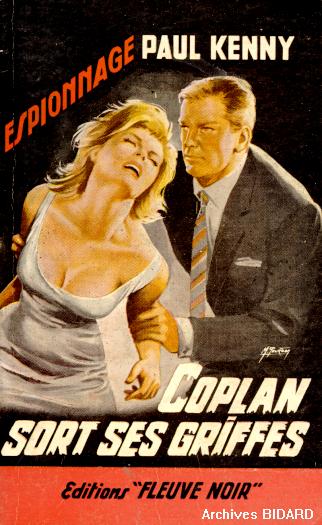
It's interesting to speculate how Action Immediate could have been a model for a Bond style spy thriller if they were made in the 50s instead of the 60s. Henri Vidal plays a sturdy, charming enough hero, but exhibits none of the decadence and amorality Connery projected in his portrayal of government agent as satyr. It's also interesting that another Coplan film was not produced until 1964 (Coplan, Agent Secret FX 18), just when international Bondmania was just taking off. Then a spate of Coplan films followed, all of them looking like the Bond knock-offs European studios churned out without discretion throughout the 1960s. But Action Immediate was the first. It's difficult to say whether Action Immediate was a one shot, or the presumed first in a series. Maybe the box office wasn't so hot and the idea for a series was shelved. Maybe the premature death of leading man Henri Vidal in 1959 put a nix on the idea. In any case, it gives us a glimpse into an alternate history of genre cinema: the spy thriller without the hegemonic weight of the Bond series.

March 27, 2004

Cine-Fotoromanzi

L'Assoluto Naturale

The Italians call them cine-fotoromanzi, a comic book which adapts a movie by using stills and frames from the movie. Here's an example, from the late 1960s Italian magazine CINESEX: an adaptation of L'Assoluto Naturale (1969), or She and He, starring Laurence Harvey and Sylva Koscina. Apparently it has a cool soundtrack by Ennio Morricone. From a Japanese Sylva Koscina tribute site, which is pretty cool if you dig 1960s era Euro-babes.

Futura Extra Bold

Futura Extra Bold --"...It was Stanley's favourite typeface. It's sans serif. He liked Helvetica and Univers, too. Clean and elegant." One interesting nugget of infomation among many brought to clear light of day as Jon Ronson receives the opportunity of a lifetime --to dig through the boxes upon boxes of the Stanley Kubrick archive. From the Guardian.

Nazi Comics

Nazi comic strips poke fun at Americans and their movies. They also bitch about Superman. Just a couple of the exhibits from the Nazi and East German Propaganda Archive.

One more: check out the Nazi board game --Stukas Attack!

March 26, 2004

Johnny Cash's Thunderball

Thunderball!

Mp3 Friday!-- forgot to put one up last week, so this time we'll have one that especially nice-- Thunderball (Johnny Cash) 3.3M

No, it's not Cash's take on Tom Jones' brassy tune, but an alternate theme for the 1965 James Bond epic. I don't know the particulars on whether it was a commissioned piece, or if it was entirely Cash's idea, but it was submitted to Eon Productions Ltd. for consideration as the theme for their biggest, boldest Bond yet.

The mind reels at the possibility, but the Cash version (which Johnny Cash wrote himself) is not a bad little number, but it's Ghost Riders of the Sky shuffle and Cash's very earnest baritone, of course, do not fit the Bond model, which in 1965 was the apotheosis of pop style. Cash's theme seems of an earlier time, where recounting a hero's deeds against evildoers in a ballad, up against the self-referential, mocking tone of the Bond films, feels as old-fashioned as a horse and buggy. This is not to say that the songs Cash wrote and sang were unsophisticated. Indeed, many of Cash's best work was darker and much more complicated, at least from a moral perspective, than anything from the Bond series. Bond, I feel, set a new paradigm for film heroes in the 1960s, one which set the decent fellow model on its ear. This new hero's amoral pursuit of pleasure, be it for sexual conquest or for the thrill of adventure, may, on the surface, make these heroes seem more complicated, but that may not always be the case. One can imagine Bond shooting a man just to watch him die, but never lamenting the circumstances, nor be tortured by the consequences like the characters in Cash's songs.

March 25, 2004

Kubrick's Polaroids.

Polaroid lighting test of Keir Dullea

Remarkable Polaroid lighting tests shot during the production of 2001: A Space Odyssey are the gems found at this German website (with German and English language versions) for a Stanley Kubrick exhibit for the Deutsches Filmmuseum in Frankfurt.

Gallo's Bunny's Brown

Glad to know there are others interested in Vincent Gallo's The Brown Bunny, and not just because of Ms. Sevigny's oral commitment. Like Anna Karina's Sweater has tons of info.


March 23, 2004

There's Always Toomorrow

The sexy and sultry Ms. Newton-John in Toomorrow

Before Xanadu, even before Grease, there was Toomorrow which features 21 year-old Olivia Newton-John and three guys as the "rock group" Toomorrow and their sci-fi adventures. Produced in 1970 by Don Kirshner, creator of the Monkees, and Harry Saltzman, who made his bones with the Bond movies, it opened with a fair amount of fanfare, but then closed after a week when the principals realized they had a dog on their hands. It was immediately shelved, and it's been screened very seldom since. Rumors state that Kirschner won't have the film re-released during his lifetime. Meanwhile, a bootleg floats around in Japan. You can hear sound clips from the Toomorrow album here.

Even before Toomorrow, there was Funny Things Happen Down Under, which was Olivia's first feature back in 1965, when she was all of 17.


March 22, 2004

KMPX and KSAN Airchecks

The counter-culture took to the airwaves in San Francisco with such "underground" radio stations like KMPX and KSAN, which provided the template for the cool laid-back stylings of FM rock radio throughout the 70s and the 80s before Clear Channel engulfed them all and any hint of personality was erased. Excepting in the case of left of the dial and college stations, to suggest that the playlists of these late 60s stations are more eclectic than those of present day radio would be so obvious as to be absurd. Find dozens of audio samples and airchecks herein, scoped and unscoped. And don't forget the flowers in your hair.


March 17, 2004

The Snotgreen Sea

It's St. Patrick's Day, and along with the wearing of the green and the prodigious consumption of alcohol, and, as sure as the nose on your face, John Ford's The Quiet Man will be playing at a TV set near you. Sodden with boozy Irish sentimentality, the sign of the cross and the fisticuffs, the fiery-haired Colleens, the rolling green fields, and Barry Fitzgerald mouthing Celtic dicta, you're sure not to find more bog fodder than this piece of fine Irish-American treacle. Where one can find the inherent contradictions of the Hibernarian soul -- its brutality and its sentimentality, its conservatism and its joy in poetry-- as inpenetrable as your fifth pint of Guinness, The Quiet Man feels as authentically Irish as green Budweiser.


March 16, 2004

Martin Amis and Saturn 3

Little did I realize that the schlocky 1980 science fiction epic Saturn 3 was scripted by none other than that mad dog Englishman Martin Amis. I wish I could somehow tie it all up, and find in Saturn 3 the germ of an exegesis to Amis' body of work, but it's been about 8 years since I've read any of Amis' books (the fantastic Time's Arrow, which probably could make a pretty good movie), and more than 20 since I've last seen Saturn 3 (which I remember as being laughably bad, but nothing more than that). What Amis got out of the endeavor was, of course, a Hollywood paycheck, but also the background for his novel Money, where the movie's actors Kirk Douglas, Farrah Fawcett, and Harvey Keitel were reimagined in the novel as Lorne Guyland, Butch Beausoleil, and Spunk Davis. As Amis later said: "It just seemed to me that when I was working on that film I was head-doctoring and kissing ass, and writing these characters as they saw themselves, as they idealised themselves."

Art imitates life, or in this case imitates trash. I haven't read Money, but it may mark my return to the Amis ouevre, perhaps in tandem with a re-viewing of Saturn 3. In any case, we can admire this Polish poster of Saturn 3, which gives it more of a pop-art Barbarella feel than I remember the movie having. The film's director, Stanley Donen has an impressive pedigree as a director of musicals for MGM in the 50s and sophisticated entertainments like Charade and Two for the Road. Donen received an honorary Oscar in 1998, more than likely not for his efforts on Saturn 3.


March 15, 2004

Hip 1960s & 1970s German TV advertising on display here. Commercials spanning from 1956 to 2002 for the German soft-drink Afri-Cola. As is usually the case, the ads from the 60s and 70s are the most creative. The cola was advertised as the "safe drug" during the tumultous year of 1968. It's still being bottled to this very day, and it has its adherents.


March 12, 2004

Hey Navajo Joe

Navajo Joe

Mp3 Friday! ....this week: Main Title-Navajo Joe (Ennio Morricone) 3.9M

This is a great track! Also a classic mid-1960s western theme from Morricone: the screeching wordless vocals, the thick twang of the Danelectro guitar, a battery of tympanis, and a frenetic Italian choir chanting "Navajo Joe! Navajo Joe!" This was composed about the same time as The Good, The Bad, and the Ugly, and there are many similarities. And while that classic tune is a pop masterpiece (and then some), the Navajo Joe Theme has almost an abrasive avant edge (but then again, so does a lot of late 1960s Italian film music).

As a film, Navajo Joe is hardly The Good, the Bad, and the Ugly (not even close), but it has its defenders. The movie's star, Burt Reynolds, thought it the worst film of his career. Then again, before the stellar reviews came pouring in, he thought Boogie Nights was a piece of shit, too.


March 09, 2004

LLLS 2 Danger in the Middle East

Also known as Danger in the Middle East

The Late-Late-Late Show Project, which is a vain attempt to track down as much information on the very obscure European programmers whose shoddily produced trailers are featured in Something Weird's The Late-Late-Late Show tape, and extrapolate like mad when the information withers, dries up, and blows away carelessly.

No. 2: Danger in the Middle East, original French title Le Bal des Espions, which translates as The Ball of Spies, or maybe, The Dance of Spies. It's Italian title is Le Schiave Bianche, which translates as White Slave Girls, a decidedly more prurient title. It has more of a pedigree than our last Late Show entry, The Fury of the Apaches. Indeed, as the narrator of the trailer proclaims at the beginning: "A newcomer among great motion picture directors, Michel Clément, has created for you the most unusual and most exciting of the new French films!", which could signal it as part of the French New Wave. Whether or not Clément was associated with the New Wave, Clément did pay his dues, working as an assistant for New Wavers' favorite Robert Bresson on Pickpocket and A Man Escaped, but there seems to be very little of Bresson's cinematic austerity in Clément's film as exhibited in the trailer. There's plenty of action, sex, and some very brutal violence (a man is pinned against a wall by a very fast moving car, a man's neck is broken barehandedly, pistol whippings aplenty, and a lot of people shot in the back). Seemingly, none of Bresson's transcendental style is evident. Also the movie has Michel Piccoli, who starred in films by Godard and Buñuel, and the stunning Françoise Arnoul, who's worked with Renoir and Rosellini.

Once again I must submit a disclaimer that I haven't seen the full movie in question, just it's trailer, but it's safe to say that Danger in the Middle East may be little more than an average actioner. This was Clément's only directorial effort. He want back to assistant work soon after

I don't believe this movie is available anywhere in any format.


March 08, 2004

Obligatory Dio Post

If for no other reason than to show how time has not dulled the creepiness of its nerdy stalker premise, here's Dio's Rainbow in the Dark , a video from the glory days of mid-80s MTV. Count the cliches, if you can. Darkness fans, take note.


March 07, 2004

Ah Sweet Vespa!

vespa calendar photo

Here's an interesting gallery of Vespa calendar images from the 50s and 60s, as fine a collection as any of European cheesecake. Included are beauties like Angie Dickinson, Jayne Mansfield, horror queen Barbara Steele, Bond girls Ursula Andress and Claudine Auger, and... John Wayne?

March 06, 2004

Going Ape Over Godzilla

Polish poster of 1st Godzilla film

The Japanese call them kaijû eiga, we call them, for lack of a better definition, Japanese monster movies, the ones where outsized creatures do battle, and stomp underfoot the toylike trappings of humanity. At one time scorned and belittled, and considered merely the province of children and developmentally arrested males, now they are considered worthy of academic study. Here is one example: an exhibit of Japanese monster movie posters from around the world at the Donald Keene Center of Japanese Culture at Columbia University.

For more Japanese poster art, check out this collection of images from Toho studios, the people responsible for most of the giant creatures we saw hopping across matinee screens.


March 05, 2004

Garota de Ipanema

Garota de Ipanema

Mp3 Friday! A new Bitter Cinema feature.... This week: Tema de Desilusao from Garota de Ipanema (com. Antonio Carlos Jobim arr. Eumir Deodato

I hate to be using another IMDB link for a movie, but if that's all you can find.... Garota de Ipanema, or The Girl from Ipanema, was made in 1967, a sort of tie-in to the famous Bossa Nova tune by Antonio Carlos Jobim and Vinicius de Moraes. I can find very little information about the film except for what you can find through the IMDB. Maybe it wasn't very good, but the soundtrack's not bad at all. The soundtrack's line-up seems like an all-star cast of Brazilian musical talent in the mid-60s: Tom Jobim, Vinicius, Chico Buarque, Elis Regina, Baden Powell, Tamba Trio, Quarteto em Cy, Nara Leao. The soundtrack's been hard to find until it was recently reissued, I think in Brazil. Now I think it's out of print again.

But here's a little taste. This tune is entitled Tema de Desilusao, which means, I think, Theme of Disillusion, which is the last track of the record. The melody should be very familiar, as it's The Girl from Ipanema, but darkly colored with minor chord progressions and a somber orchestration. The melody is, of course, Jobim's, but the arrangement was by Eumir Deodato, who later scored a hit in the U.S. with his jazz-fusion take on Also Sprach Zarathustra, which we all know as the 2001 Theme. I'm assuming that the disillusion occurs when the girl from Ipanema walks away, impervious to the main character's attention. Or maybe someone gets killed in a boating accident, and life is seen as a strange folly. Disillusionment comes in many shades of gray.

As an aside, Helo Pinheiro, the actual inspiration for the original song, and has used her modicum of notoriety to some advantage, appeared recently with her daughter in a pictorial in the Brazilian edition of Playboy. Olha que coisa mais linda!


March 04, 2004

LLLS 1 The Fury of the Apaches

The Fury of the Apaches

The Late-Late-Late Show Project (as referenced here)

No. 1: Fury of the Apaches, original Spanish title El Hombre de la Diligencia, which could translate as The Man of Diligence, or The Diligent Man (as in a thorough and careful fellow), but more than likely means The Man from the Stagecoach, or Stagecoach Man, as there's a stagecoach in this movie trailer, the first in Something Weird's The Late-Late-Late Show video comp, but there's very few diligent men, unless they're diligent about killing Apaches.

Fury of the Apaches was a Spanish-Italian co-production from 1964, which incidentally was the same year Leone and Eastwood broke new ground with A Fistful of Dollars. No two European westerns could seem further apart, either stylistically or philosophically. This is not an indictment on The Fury of the Apaches, but it shows the aesthetic broad-jump A Fistful of Dollars made within the genre.

Of course, this reading is made solely on viewing the trailer, not the actual feature film, so whatever critical judgments I make are clearly suspect. The Fury of the Apaches could be a magnificent film. It could be playing with the tropes and conventions of the genre. It could be the work of an inspired hand. It's director, Jose Maria Elorrieta, began his film career making short documentaries on Spanish painters and architectural treasures, so he may understand pictorial style. He also wrote many of the films he directed. However, glancing through his filmography one sees the straight and narrow road of a journeyman, a man who kept his fingers in many pies, generically speaking, from an early 60s sentimental convent drama starring Soledad Miranda, a wacky and sexy 1967 fantasy-comedy with Jeffrey Hunter, and an early 70s vampire film, and westerns like Fury of the Apaches. It could be that the inhuman butchers who edited the trailer and wrote the accompanying copy, drained the subtle beauty from the original, purged its moral ambiguity, removed the ahead-of its-time sensitive portrayal of Native Americans, and in its stead had a manly stentorian voice read over gunshots, whistling bullets, galloping horses, shrieking Apache war cries:

An epic episode in this epic story of the West. As our pioneers face the fury and terror of a savage land and a still more savage people. The paleface frantically search for gold but often found... The Fury of the Apaches!

Liza Moreno

Instead, we have a carnival of cliche. Here's one exchange. Our hero, Major Loman, portrayed by American Frank Latimore, fights another fellow and then holds him at bay with a loaded Winchester. In between them stands Ruth, played by our female lead, the lovely Filipina Liza Moreno (whose own filmography includes a turn as Darna, the Philippines' biggest comic book heroine). She speaks:

"Don't shoot Loman. Don't. For my sake." (Rather unspiritedly)

In walks another fellow, who surveys the situation bemusedly. He speaks:

"You two have found a good time to kill each other! You two! Why don't you wait 'til we got rid of the Apaches!" (In a campy Paul Lynde kind of voice)

You get the gist. Remember those scenes in old movies when someone would turn on a TV set, a cowboy and Indian movie would come on? The generic late movie (at least from the fifties and sixties), the western everybody's seen for a million times? Imagine your grandad, flipping through the TV Guide after dinner on the easy chair in 1967, finding Fury of the Apaches is coming on at 8 on channel 9, lighting his first Pall Mall of the evening, gets off the chair with a grunt, clicks the dial to 9, adjusts the "goddamn" rabbit ears, settles down with a cold can of Ballantine Ale, farts. Within 30 minutes, in between ads for Tareyton cigarettes and Lou's Used Car Emporium, grandpa's out like a light. Later, grandma nudges him awake and she leads him to bed. Does he tell his buddies at the plant about the wonderful find he saw the night before?

Hell no. He leaves it for his smartass grandkids, college educated but barely making a living, to spend way too much effort on some paella-spaghetti western he may have given the time of day (and only that). Then again, he may have known it as Apache Fury, which was its original American title. Or perhaps he knew it as Ranch of the Doomed? Who would give a shit about some cowboy picture?

Indeed. I was ready to quickly dismiss Fury of the Apaches as a reactionary western, perhaps even Francoist one, at least in the trailer's depiction of the Apaches. Even John Ford was enlightened about the Indians in 1964. Then I found a blurb on the film (yes, you can have it on VHS):

Geronimo's Apaches attack a stage coach full of people who take refuge in the wrong place at the wrong time. On board is the infamous Judge Driscoll (George Gordon) and his lovely fiancee Ruth (Liza Moreno) who are on their way to the altar with a fortune packed away in their belongings. Waiting at an abandoned rest stop is Loweman (Frank Latimore), the man Driscoll sent to prison years before so he could steal the man's gold mines. Meanwhile, the Apaches continue their attacks joined by another tribe. To make a bad situation worse, tensions are mounting, tempers flaring and Driscoll's connection to Ruth's first husband's death is revealed within the claustrophobic confines of the rest station. More of a Soap Opera than a Horse Opera, the personal bits of bitter history the characters share are as scary as the Indian raids.

It's a Douglas Sirk western! Imagine Almodovar in 1964, lensing a western!

The Western genre as our grandfathers knew it is, for the most part, dead. Westerns are still produced, but very seldom. Clint Eastwood, the last great master of the Western genre, hasn't made one in 12 years. The dusty excitement the Western provided to audiences two generations ago, like the grimy thrills of 70s crime thrillers, and the techo-shocks of today's quasi-sci-fi product, are all one and the same. It's the same story but in a different context. But what makes older films interesting is when it's seen in a different context, i.e. the Western as soap opera. It's what makes contemporary films interesting as well. Just watch!


March 03, 2004

Nightmare Theatre

Another cool one! Vintage audio from Nightmare Theatre with "Dr. Cadaverino" on WITI-TV in Milwaukee. The site's got a lot of great information, including the "Shock" horror movie package sold to local TV stations in the late 50s.


March 02, 2004

THE LATE-LATE-LATE SHOW

Picked up a tape from a local video shop yesterday, and now I'm completely obsessed about it. It's name is THE LATE-LATE-LATE SHOW, and it's a collection of trailers from Something Weird Video. As the copy on the box states:

For all you Insomniacs who saw these obscure European espionage movies, westerns, thrillers and historical dramas of the early Sixties on TV: The Fury of the Apaches, Danger of the Middle East, To Catch a Spy, Agent of Doom, MMM 83, X-Ray of a Killer, Lost Treasure of the Aztecs, Eyes of the Sahara, Dangerous Agent, King of the Vikings, Duel of Fire, Walls of Fear, Stranger from Hong Kong, Killer Spy, Secret File 1413, Operation Gold Ingot, Escape from Saigon, Headlines of Destruction, The Black Monocle, Death Pays in Dollars, Sergeant X of the Foreign Legion, Nest of Spies, Prisoner of the Jungle, Messalina, Hercules of the Desert, Sea Fighter, Destination Fury, Prisoner of the Iron Mask, Musketeers of the Sea, and the 1952 suspense short THE GENTLEMAN IN ROOM 6.

Even in this time of all-inclusive film scholarship and, thanks to the internet, a very informed fanbase with reams of documentation at their fingertips, these are films that are, for the most part, forgotten. Most the films whose trailers I saw were European spy thrillers (mainly French from what I can ascertain) produced in the late 1950s and early 1960s. This was before Bond-mania took over half of the world, and Euro-spy programmers became parodies and goofy pop-art extravaganzas. But what of their predecessors, these very humble and earnest black and white thrillers? As Something Weird's box copy so implies: these were cheap gut-bucket flicks that local TV needed to fill holes in their schedule. Back in the 1960s and 1970s, time needed to be filled for programming, and movies were the cheapest way to fill that time. Mainly these were packages from studios like A.I.P. that were mainly european programmers picked up for a song and then re-edited, cheaply dubbed and retitled. If you're old enough, maybe you remember a morning movie, or an afternoon movie, maybe tied in to a sweepstakes or contest. Remember when there used to be Late Late Movies, and not infomercials?

I certainly do. Watch this space for more information. I intend to track some of this stuff down.


March 01, 2004

Euro-Spy Royale

Attack of the Robots... starring Eddie Constantine... directed by Jesus Franco. Contrary to some reports, it's not a Lemmy Caution movie.

Here's something cool, a gallery of European spy movie posters from the 1960s!


Genuine Dislike of Mel Gibson

"His actions were also partially due to a genuine dislike of Mel Gibson...." For some reason I find this very funny. He's got some balls, that kid!

February 29, 2004

Best Foreign Language?

The intriguing politics of the best foreign-language Oscar. The NY Times explains why City of God was nominated for four Oscars this year, but wasn't for a foreign language award last year. Art meets commerce meets diplomacy meets governmental bureaucracy meets yearly Academy Award silliness.

February 26, 2004

Strictly Adults Only!

Here's the U.S. Catholic Bishop's take on Mel Gibson's The Passion of the Christ. Strictly adults only.

February 02, 2004

Exorcistland!

The United States Army is setting up attraction in Iraq called "The Exorcist Experience, which will link several locations in Iraq where scenes of The Exorcist were filmed. As tremendous fan of the movie, a little bit of me thinks this is a little bit cool, but it's interesting and sad that we (speaking as Americans) can only grasp and comprehend history through and by Hollywood movies. It's as if a history as grand and ancient as Mesopotamia's can only be seen and understood in the context of how it fits into the narrative of a horror movie.

January 30, 2004

Where's America Popular?

Interesting, scholarly, but eminently readable piece by literary "anti-theorist" Franco Moretti that methodically details in which nations American films are popular, and what kind of films are popular there. For example: Jamaicans seem to love American action films; they're Jamaica's favorite movie genre. At the other end, Austrians could care less.

January 25, 2004

Oohs and Ahhs

Just how far can special effects go, merely as an end to itself? There appears to be a very fine line between something that can be awe-inspiring, eliciting oohs and ahhs from the sugar-drunk masses, and mere ludicrousness (a racing bike whipping around a palm tree in Torque). One can lament the the dearth of the human element in movies, but spectacle is probably cinema's oldest tradition, dating back to its origins in exhibitions in carnival tents, spectators ducking and scurrying as the Lumières' train pulled into the station at La Ciotat, the magic tricks of the illusionist Méliès. One can rail against the carnival ride aspect of a lot of modern movies, but that would be as fruitful and wise as charging Hollywood with putting a dollar before art, which is the same as complaining about the weather.

January 24, 2004

TV Archeology

From Television City in Hollywood....The Newest Things on Wheels

An incredible piece of television archeology. Read about the star studded extravaganza the Ford Motor Company sponsored on CBS in 1957, The Edsel Show! Then marvel at the perseverence and success of one man's search for the program's original video tape. Then feast your eyes and ears on a Quicktime snippet of the show's opening. The sound quality of the broadband version is quite incredible!

January 23, 2004

Vampire Bubble Gum

Vampire Bubble Gum

For only a penny Vampire Bubble Gum can be yours. Maybe these monster candy cigarette packages can be yours for the same price. A lot of fun stuff at Tick Tock Toys.

Amon Duul 1968

Amon Duul I 1968

Images of Amon Duul live in 1968. Pictures of other Krautrock luminaries too.

December 06, 2003

The Brown Bunny

An update on Vincent Gallo's The Brown Bunny. Apparently it's been recut and it's won a critic's prize at the Vienna Film Festival. Here's Chris Fujiwara's take.

September 26, 2003

Forbidden Periodicals

Featuring: Meet Me at the Tomb...The Shelf of Skulls...Death Claws...plus other suspense packed stories that shock.

I remember these kinds of forbidden periodicals spied from the corner of my eye at squeaky magazine racks--at the bottom, next to the detective magazines more than thirty years ago. More than likely it was an Eerie Publication, which specialized in horror comics (in magazine format, in order to beat the Comics Code) with especially gruesome covers. Sometimes, the art directors at Eerie got a little lazy. See (1) See (2)... Sometimes they added way too many monsters.

September 25, 2003

Sometimes Jawdropping

A live H-Bomb was aimed right at the heart of the world's greatest city.

A great and sometimes jawdropping collection of cool but sleazy pulp cover art of the fifties and sixties from Hip Pocket Sleaze, including this oddly prescient cover of a cheap sixties paperback.


August 11, 2003

Dr. Wertham Presumes

P-Put The Needle Down!! No!

Dr. Wertham Presumes. A selection of the "worst" in comic books up until Frederic Wertham wrote his silly book. Then again, if it wasn't for the un-Jung Wertham, we would never have known the lowdown on Batman and Robin.


August 10, 2003

Keep Hope Alive

Bob pushing the smokes

Thanks a lot, Bob. Unlike today's pampered overcompensated stars, who feel they're above shilling product unless they're whoring themselves in Japan, in earlier and simpler times, big time celebrities like Bob Hope had no compunction with hawking razor blades, cigarettes, and chocolate. He also had no compunction about doing an anti-gay bashing PSA in 1988.

Pee Movie List

"The Pee Movie List is intended to be the world's most comprehensive and thorough guide to urination in the cinema." It's a form of scholarship, at least.

July 29, 2003

Next Stop: Nowhere!

Next Stop Nowhere was the the title of the infamous Quincy Punk Rock Episode. It aired in December of '82, but everyone spoke of punk rock as some sort of new fad. Dig the prefab nihilism of Mayhem and their stirring balls out "Get Up (I Want to See You Choke)". Note the embarassment and sly ridicule of actual fans being employed as extras to lend some local color.

July 08, 2003

Ingmar!!

Scene from The Naked Night, aka Sawdust and Tinsel

A photo gallery featuring the work of Swedish director Ingmar Bergman. Also, an interesting article from Bright Lights Film Journal on how Bergman has undeservedly fallen in favor with critics and scholars.

June 26, 2003

More Werewolf, More Vampire Woman

Nothing sexier than a vampiress in abject panic. Except perhaps two vampiresses.

Here's an addendum to the latest movie poster essay on The Werewolf vs. Vampire Woman. I rented out a ratty looking VHS copy that, based on the condition of the cassette and the cover art, must have been at least 15 years old. The version was called Blood Moon, though, and the copy, considering its age, was in pretty good condition, probably because no one's watched it in those 15 years. Which is a shame, because while by conventional criteria, it's not a good movie at all (the usual suspects: Naschy's casual acting style, where he gives El Santo a run for his money for expressiveness and emotional shading; the murky day for night photography, the bane of the zoom; the old saw narrative; half-there filmmaking). But it's not bad either. I would even venture to say that there are moments in La Noche de Walpurgis that approach pure cinema poetry, in the sense that filmic poetry is an instant in a movie that's more unwieldy than any string of words can explain, obfuscate, conceal, or replicate. There was a complication of dumb emotion and clinical eyeballing, a frisson and derision that I experienced watching two vampire women play ring-around-the-rosies in slow motion (in a dream sequence no less). It was an odd moment within the context of the film; but those 15 or so seconds of cinema made the rest of the 90 minute movie seem worthwhile.

June 01, 2003

It's About Time

Another silly sitcom from the 'sixties's, It's About Time dealt with astronauts breaking the time barrier and landing on prehistoric earth. Despite its fast and loose interpretations of Einsteinian physics, it played for only season on CBS in '66-'67, and never made it on syndication as far as I know. I seem to remember it vaguely, especially it's theme song.

New Poster Essay

It's about time...it's about space...about strange people in the strangest place... actually it's about the new poster and essay which you can find here. Took me a bit longer than I expected, but that's what happens when you subject yourself to self-imposed deadlines.

May 31, 2003

Unused DVD Commentaries

Unused DVD commentaries from McSweeney's: Ann Coulter and Dinesh D'Souza on Aliens

COULTER: It's not Hicks's fault. It's Gorman's. Hicks has a shotgun. And I have to say, my heart sort of pitter-patters when he cocks it. I just like the sound. Oh, my. Here the Corporation Marines have stumbled across a wall-implanted nest of dead and near-dead colonists. My question about this sequence, though, is this: If a woman is pregnant with an alien, does she have the right to an abortion? D'SOUZA: That's a tricky one. COULTER: Because we see here that some of the colonists have, in fact, been impregnated by aliens. D'SOUZA: I'm going to make an uncharacteristic admission for both of us: this is a tough, complicated issue. On the one hand you have these unborn aliens, and their lives are sacred. But really, these humans are in no way equipped to take care of them adequately once they're born. COULTER: So they should go ahead and give birth to the alien, but destroy it immediately afterwards? D'SOUZA: I think so, yes.

Also, Howard Zinn and Noam Chomsky on The Fellowship of the Ring.

May 28, 2003

The Bunny's Brown

Is Vincent Gallo's The Brown Bunny as bad as everyone's making it out to be? Its Cannes Festival premiere welcomed by catcalls, boos, and a litany of the most scathing and virulent pans, many critcs (stately, plump Roger Ebert among them) considered it the worst feature in the entire history of the Cannes International Film Festival. After the movie's less than frosty reception, Gallo apologized for the film and vowed never to make another. The next day, Gallo fervently defended his film. "I'm still very moved by it," he said.

There are other defenders of The Brown Bunny, but one wonders if it will even see a small and narrow theatrical release, considering that the climax of the film consists of a graphic ten minute fellatio sequence starring, of course, Gallo, and his co-star Chloe Sevigny. The first film maudit of 2003.

Call me perverse, but I would really like to see this (and not just for the blow-job either). We need more outlandish ideas, Russian roulette with a movie camera --not being afraid to fall flat on your face, not falling victim to the fear of failure, not giving a shit. Vincent Gallo, a lot of people consider you a prick, and you may well be, but you decided to make the movie you really wanted to make and pissed off a lot of people in the process. For that I salute you. I think I'll be watching Buffalo '66 tonight.

Elephant Wins!

Some quick news about the awards at the Cannes film festival. Gus Van Sant wins big with his Columbine inspired Elephant with both the Palme d'Or and the best director's prize.

May 26, 2003

Groovy Film Music

Looking for some groovy film music? Look no further, and direct your browser to Exploitika! 60's & 70's Soundtrack Radio, where they have two streams running (under the auspices of Live365), Cinegroovin', which dedicates itself to the groovier '60's and '70's movie sounds, and Bloodstream, which specializes in horror film soundtracks from the '60's to the present. If it's any indication, I've been listening a lot to the Cinegroovin' stream. A lot funkier and jazzier. If you're into prog, you might dig the darker sounds of Bloodstream ( a lot of Keith Emerson, Rik Wakeman, and, of course, Goblin.

For more streaming sounds, head over to A Fistful of Soundtracks which, maybe not as esoteric as Exploitika, carries a lot of cool movie sounds, complete with back announcing like a college dj! Then you have Streamingsoundtracks.com, while more mainstream than the others I've listed, has a choice of streams based on bandwidth, and, independent of Live365, carries no advertising. It also has the largest library, so it probably won't be prone to repeating itself as the others.

For info on some of the groovier tracks, check out Score, Baby!, where you can find audio samples and cover pics of '70's Six Million Dollar Man and Kojak kid comic book/records, which I saw when I was a kid, but was of course too cool to ask my parents to buy. Stupid! Movie Grooves, out of the UK, specializes in selling this lind of esoterica, like Kosmos, a collection of cues from '60's and '70's East German science fiction films.

May 23, 2003

Intertitle-o-Rama

Intertitle-o-Rama is a wild and very interesting collection of the oddest intertitles found in silent movies. Be warned: some of the expressions used in these old (80 to 90 year old) film intertitles are quite quaint and silly, while others would nowadays be quite scandalous and downright insensitive. No doubt, in 90 years time, much of the expressions of our popular culture would seem as dusty and incorrect.

Here's one I particularly like, from Cecil B. DeMille's 1923 version of The Ten Commandments:

"I told you I'd break the Ten Commandments - and look what I've got for it, SUCCESS! That's all that counts! I'm sorry if your God doesn't like it - but this is my party, not His!"

Here's another beauty, from The Thief of Bagdad:

"You shall add joy to the wedding festival by being boiled in oil."

May 21, 2003

Dylan by Scorsese

Seems rather odd that it should be the BBC backing a Bob Dylan career retrospective-interview-documentary directed by Martin Scorsese, rather than an American media conglomerate. Wouldn't this be the coup to end all coup de graces? I mean, aren't these two men, no matter how they would place (or not place) on your own personal pantheon, the most influential American artists in their own particular fields still living? It'll be on PBS here in the states, but it'll probably be on during pledge time. I'll probably be watching in any case.

May 19, 2003

Pimpadelic Wonderland

I grew up during the 'seventies, but I didn't see any of these when I was a kid. Maybe as a jaded adult in the 'eighties and 'nineties, but that's thanks to home video. A lot of wacked out stuff here. Some worthy of tracking down. From Pimpadelic Wonderland, a fine sight indeed.

May 17, 2003

Film Noir Posters


The one spot of color in the otherwise monochromatic world of Film Noir was probably it's advertising. The guns, the painted faces of femme fatales, the garish green and reds suggesting menace, the violence of the typography, promised the cruelty, but none of the moral ambivalence of the best of the Noir films. This is not a slam against the posters, but, rather, an acknowledgement of the peculiar artform of the movie poster, whose very existence is inextricably linked (perhaps subserviant) to another work of art, but can also carry its own aesthetic rules. Which is to say that the movie posters are very cool in and of themselves, and can be appreciated without knowing the film they're promoting (perhaps even more so, as if the weight of the film's content and reputation has been lifted from the viewer's mind and the eye can fully concentrate on the pictorial elements of the poster). But a very good poster for a very good movie can be sublime, complimenting each other, adding meaning and context.
Here's the introductory essay by Eddie Muller for his book The Art of Noir: Posters and Graphics from the Classic Film Noir Era, published by Overlook Press, complete with a few examples. It looks like something to get.

May 15, 2003

Corndogs


The Minutemen were one of the best rock bands in America during the 'eighties. There are many times I feel they were the best, period: brittle insurgent jazzfunkpunk for the workers; aural samizdat for the less than zero 'eighties; less than perfect revolutionaries whose lyrics emphasized personal testimonies and pothead poetry over polemics, bathroom wall slogans over sliced and diced dialectics, but with a warmth, humor, and, above all, a palpable heartfelt sincerity that belied their self-description as "scientist rock". And, no, the Minutemen are not responsible for nu-metal.
In 1985, SST Records were set to release Corndogs, a video history and document of the band. Legend has it that the master tape was stolen from the van that was heading for the duplication plant where it would be manufactured. Unbelievably, this was the only copy. Cheap dupes did exist and circulate, but they were more than several generations away from the original, contained gaps in the continuity, and had a time stamp on the lower lefthand corner. These were the only copies around.
One of these copies was posted on the Corndogs.org which compiles "live and rare audio and video form various Mike Watt incarnations", which, of course, includes the Minutemen. It's a great site, with tons of audio stuff. And it also includes about all that's available from the Corndogs video. It's pretty crappy looking, but it's the best we've got, plus it's the Minutemen. Quicktime format.

May 14, 2003

Drakula Istanbul'da

Long believed lost, Turkey's Drakula Istanbul'da ("Dracula in Istanbul") is considered the first non-western film version of the Dracula story, and oddly one of most faithful to the Bram Stoker original. With Dracula scaling the castle walls, implied infanticide, and the ceremonious end of the vampire, with first the staking, then followed by a beheading, and then stuffing the mouth with garlic (as per the instructions in the novel), this movie adaption contains more of the creepier elements of the book than higher-budgeted and more pedigreed productions. Perhaps it's the proximity of Turkey to the Eastern Europe setting of the first part of the novel, or perhaps sharing similar legends and folklore, but Drakula Istanbul'da, in all it's threadbare grace, seem to have an authentic and maybe innate feel for the myths of the region that cannot be found in any Hollywood backlot. A connection is made in the film between the Count Dracula in the story and the real Vlad the Impaler, who, of course, impaled mainly Turks.

The film has been frequently written about, but very rarely seen, but now you can, courtesy of Turk Sinemasy, right here. Windows media required.

May 12, 2003

El Monje Loco


I've been scouring the internet, and invaded warm and sweet-smelling newsstands in Tamaulipas, Mexico, asked people whom I thought were in the know, looking for any information about the radio host and comic book character El Monje Loco. A sort of Crypt Keeper from south of the border, "The Mad Monk" was a mainstay of Mexican comic books from the 'fifties until the 'seventies. I first read about him in the Headpress zine from the UK, although, unfortunately, an online version is not available. Any info coming my way would be greatly appreciated.

May 10, 2003

Werewolf Page


Found this one quite by accident, but it's a good one, werewolfpage.com. All sorts of wonderful illustrations, from movie stills to weird medieval engravings. It also deals with the myths and legends of lycanthropy, and also adds some case histories, such as the odd story of the African were-crocodile.

May 09, 2003

Martin Scorsese's Guilty Pleasures

Everyone has guilty pleasures. Even Martin Scorsese.

May 06, 2003

Jandek

I've never been able to listen to a Jandek album all the way through. It's jarring and noisy stuff, and I like jarring and noisy stuff. But it's not just the atonal noodlings and rhythmic miscarriages that leave me exasperated, frustrated, drained, even depressed, but the emotional nakedness, the brittle honesty in the songs. It's a lonely, sometimes scary music, childlike in a lot of ways, if the child was a precocious hyperactive shut-in. An intriguing, unique artist. Funny thing is no one knows anything about the man: who he is, where he's from (although Houston would be a good guess), his philosophy of music, his philosophy of life, his favorite color...anything. Which makes him the perfect subject for a documentary, Jandek on Corwood. You can see the 2 min. trailer here. This is definitely something I will be looking for.

May 05, 2003

Updates!

Yes, this site hasn't been updated a lot, but I think I'm going to give it another shot. I've updated the design, made things look a little bit cleaner, and I'm hoping to post more frequently. If anyone's interested, here's what the old design looked like. I must admit I like the Kiss Me Deadly logo. Here's one based on L'Age D'Or.

May 04, 2003

New Poster!

The new poster's up and you can see and read about it here. I hope to update it weekly, although bi-weekly seems more plausible. I really don't have a set format for it yet. Essentially I'll be posting interesting looking movie posters and I'll be writing about them or the movie they're promoting. Some of the commentary may be short, and some may be considerably longer. I may have gone a bit overboard here, but I enjoyed writing it and I also like the movie a lot. Need to exercise the writing muscles anyway. They've become fatty, thick and dull, and my pen hand's been all thumbs.